Ieoh Ming Pei: City Hall, 1972C–1978
- Dallas, Texas, USA, Show on map
- #GOV #Public #InvertedPyramid #North America
-
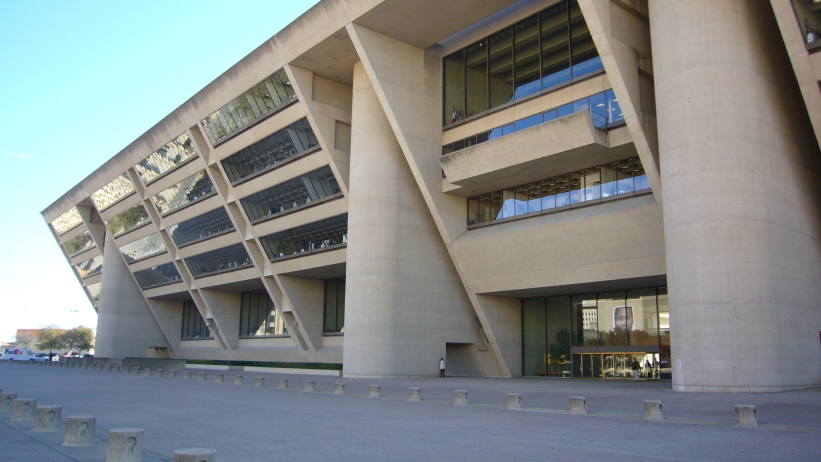
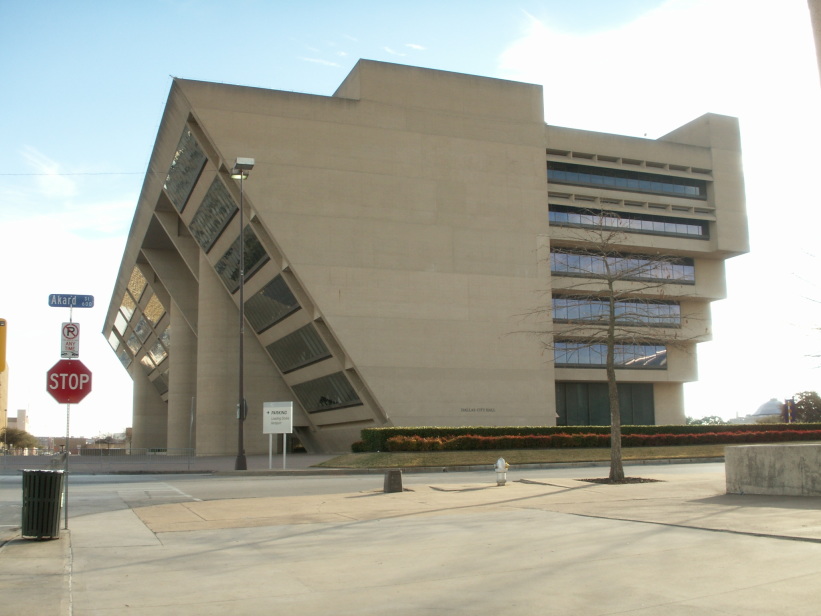
In deliberate contrast to the surrounding high-rises, the horizontally articulated Dallas City Hall stands on a wide downtown site. An open plaza, featuring a reflecting pool and sculptures by Henry Moore, sets the stage for this building by architect I. M. Pei. Rising in the form of an inverted pyramid of buff-colored exposed concrete, it functions both as a monumental architectural sculpture and as an inviting civic gesture: the deep overhang of the sloping structure provides shade and shelter for pedestrians, protecting them from weather and the Texas sun. The 171 m long building inclines at an angle of 34°, with each of the seven above-grade floors extending approximately 2.7 m beyond the level below. This striking shape directly expresses its internal organization: while the public service areas on the first and second floors required comparatively little space, the governmental offices above demanded larger floor plates, a functional hierarchy that is inscribed into the building’s very geometry.
Dallas City Hall is an early example of Pei’s monumental, geometrically defined civic architecture, which represents a precise, legible form in urban space. Within Pei’s oeuvre, it exemplifies the triangle as a recurring motif, as seen, for example, in his extension to the National Gallery of Art in Washington, D.C. (1968–1978), the Bank of China Tower in Hong Kong (1982–1990) and the glass pyramid in the courtyard of the Louvre (1985–1989) in France.
Pei’s building for Dallas emerged in the course of the city’s effort to reinvent its public image after the assassination of John F. Kennedy in 1963 and was positively received even before its completion. In 1976, the New York Times described it as “a turning point for the city,” characterizing it as “calculatedly symbolic, and overwhelmingly strong” and as a decisive architectural image-maker for Dallas itself. Together with Boston City Hall (1962–1968), it has been regarded as “among the most interesting urban constructions of the twentieth century.”
-
Currently under serious threat as the City of Dallas considers relocating the municipal administration and selling the site, putting the building at risk of redevelopment and demolition. A petition and the initiative “Save Dallas City Hall” are campaigning for its preservation.
The building received an Excellence Award from the American Consulting Engineers Council in 1979 and the Texas Society of Architects’ 25-Year Award in 2015.
Dallas City Hall appears in the movie RoboCop (1987), where it is depicted with a digitally added extension (last updated on February 27, 2026).