Mario Pani: Presidente Alemán Social Housing, 1947D–1949
- Mexico City, Mexico, Show on map
- #RES #Latin America
-
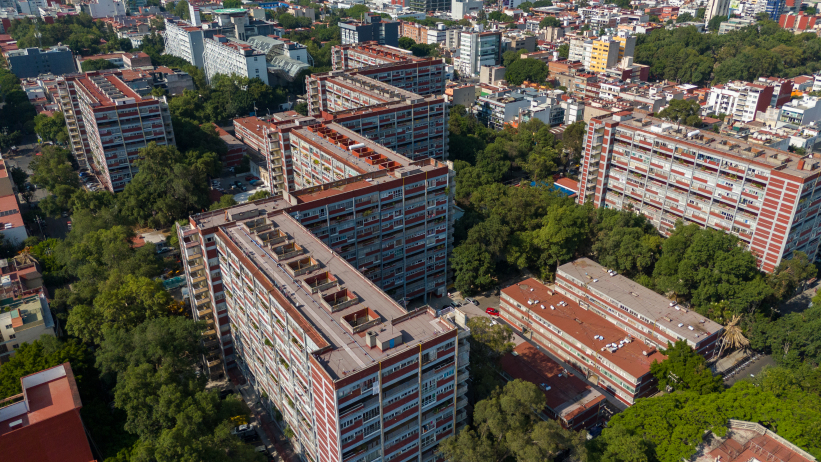
The Mexican architect Mario Pani studied architecture at the prestigious École des Beaux-Arts in Paris during the 1930s where he attended lectures by Le Corbusier and was influenced by his city visions. At the end of the 1940s, Mexico City experienced massive waves of migration from the countryside that doubled the city’s population in less than ten years. On a large plot of undeveloped land to the south of the city the young architect was able to realize his ideas given the freedom to experiment and design the Multifamiliar Alemán far from the bustling city center. He took the challenge to find a synthesis between the modernist “internationalist style” and Mexico’s postrevolutionary nationalist ethos. Providing greenspace and sunlight in between, six high-rise buildings were laid out in a diagonal “zig-zag”. At the center of the complex Pani created a swimming pool, surrounded by gardens and walls that featured pre-Hispanic symbols.
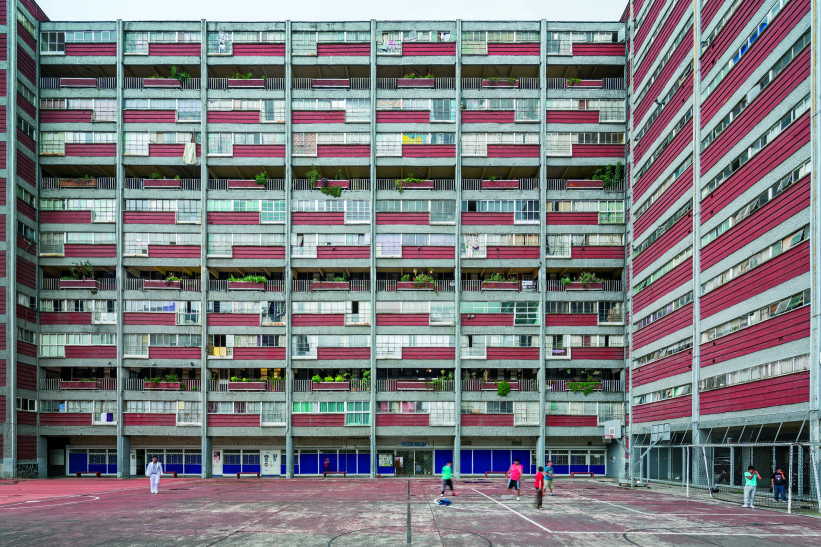
The Centro Urbano Presidente Alemán was the result of a state-sponsored architectural competition launched in July 1947. Mario Pani won the competition with a proposal that sought to reconcile optimal land use, high residential density and housing quality with controlled construction costs. Occupying a superblock of approximately 40,000 square meters, the complex originally comprised 1,080 rental apartments. It combines six high-rise buildings (ground floor plus twelve residential levels) with six three-storey blocks. The ground floors of the taller buildings were partly used for shops serving the residents, reinforcing the idea of a self-sufficient urban unit. Drawing on housing concepts developed by Le Corbusier like the Unité d’Habitation, Pani developed maisonette apartments arranged around central light shafts. Exterior access corridors, made possible by the local climate, provided natural ventilation and daylight, while jardinières softened the circulation spaces. The façades are articulated through raw concrete frames with red brick infill, a material choice intended to reduce maintenance while giving the ensemble a distinct architectural identity.
-
In use (last updated on January 20, 2026).