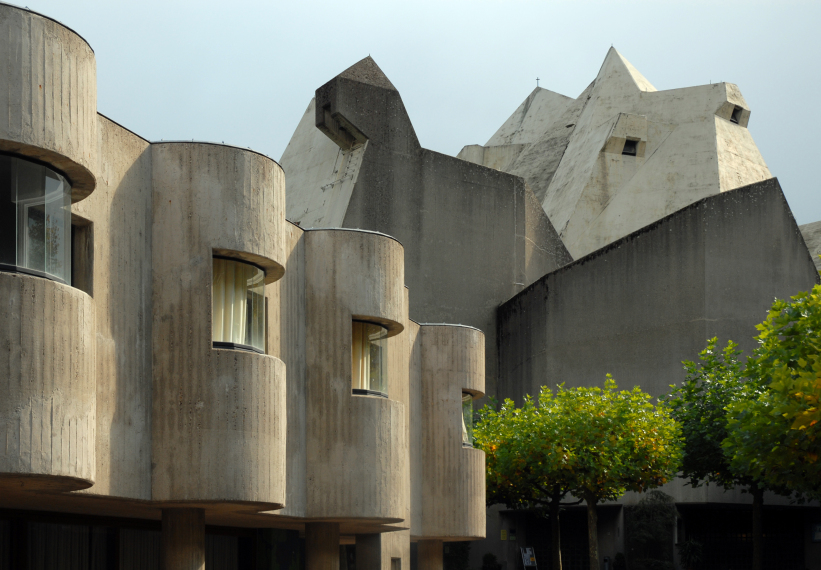
Gottfried Böhm: Wallfahrtskirche „Maria, Königin des Friedens“ (Mary, Queen of Peace Pilgrimage Church), 1963D–1973
- Neviges, Germany, Show on map
- #REL #CastInPlaceConcrete #Sculptural #ConcreteMonster #ConcreteLandscape #Monolith #FeaturedPhotographer #Klaas Vermaas #BestPractices #Western Europe
-
A Second Skin: The Renovation of the Pilgrimage Church in Neviges
By Miriam Kremser · Published December 10, 2025
The pilgrimage church in Neviges is one of Pritzker Prize winner Gottfried Böhm’s most significant works. However, only a few years after its completion, its distinctive folded concrete roof began to crack and leak. As a result, an epoxy resin coating was applied in the 1980s, yet this soon began to flake off. During a second renovation undertaken from 2016 to 2021, a sort of second skin, in the form of an innovative layer of textile concrete, was applied across the entire roof. This strategy appears to have been technically successful, but it raises a conceptual question for heritage conservation: should renovated components of a building blend in or stand out from the existing structure? This is part 1 of our four-part Best Practices series showcasing examples of successful renovations, gathered for the 10th anniversary of the SOS Brutalism online campaign (on the Gallery page, search for #BestPractices).
The architecture
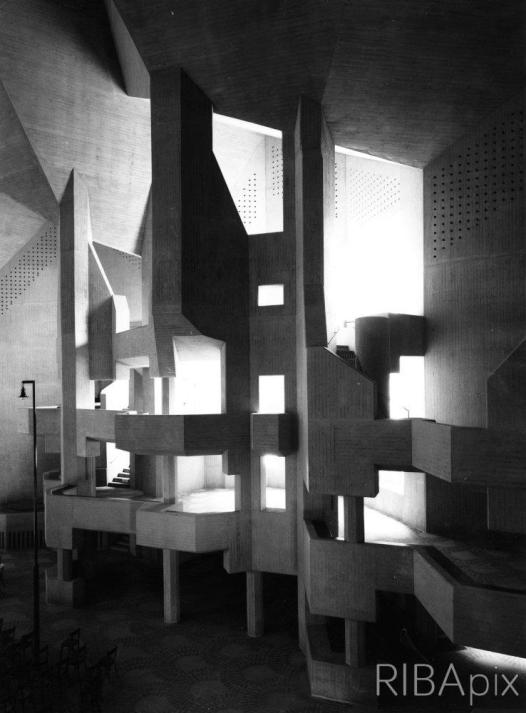
Since 1968, a huge formation of exposed concrete peaks has towered over the small-scale roofscape of the German town of Neviges. This is the pilgrimage church Mary, Queen of Peace, whose design arose from an architecture competition held in the early 1960s. Pilgrims have traveled to Neviges since the late 17th century to venerate a small portrait of the Virgin Mary associated with miraculous healing. Following the two world wars, the former pilgrimage church became too small to accommodate the ever-increasing crowds. In a competition held to design an expanded church and pilgrimage center, Gottfried Böhm impressed the jury with a building ensemble executed in exposed concrete. The design included a kindergarten building and a pilgrim’s house arranged on a slope in such a way that they frame a stepped pilgrimage path leading upward toward the new church. The pilgrimage church is constructed at the path’s highest point on an irregular, polygonal floor plan, from which tall, sandblasted walls develop before culminating in the audaciously folded and self-supporting roof. Horizontal wooden formwork patterns were left to mark the roof’s surface. This sculptural work of architecture, almost monolithic in its appearance, gives the impression of a mountain range made of exposed concrete. Böhm’s pilgrimage church is the second-largest church in the Archdiocese of Cologne, after the Cologne Cathedral.
-
Why the building was in danger
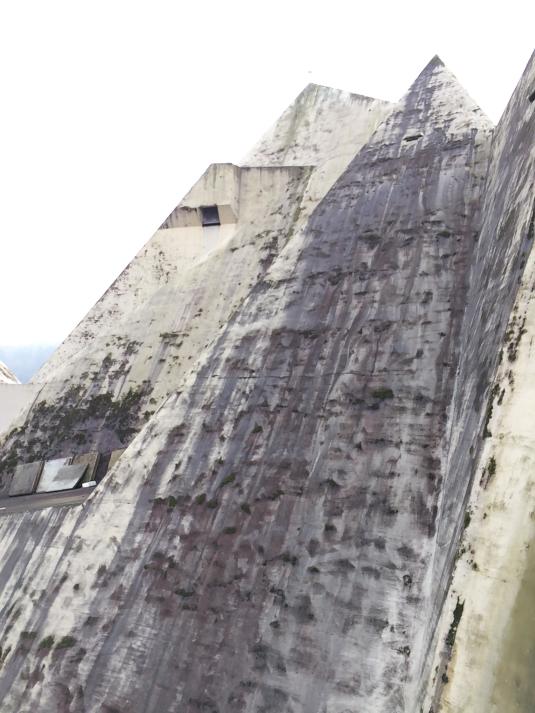
The sculptural folds of the reinforced concrete building, however, did not only garner praise; they also caused certain difficulties. Only a few years after the structure’s completion, cracks caused by temperature fluctuations began forming in the various folds and corners of the roof. As a result, water penetrated into the interior, compromising the building’s function as a church and damaging its built substance. To seal the cracks, a coating of gray epoxy resin was applied over the entire surface of the roof in the 1980s—an instance of the widespread misconception that exposed concrete façades can easily be “freshened up” with a coat of gray paint. For one thing, this destroyed the impact conveyed by the texture of the rough formwork. Above all, however, the measure failed to achieve its intended aim, as the epoxy resin coating could not arrest the roof’s ongoing thermal movement and the cracks reappeared. In the process, parts of the colored synthetic resin came loose, resulting in an unattractive checkered appearance.
How the renovation unfolded
Since August 2021, the entire roof has been covered with an innovative, 3.5-cm-thick layer of textile concrete. This novel technique was developed at the Institut für Bauforschung (Institute for Building Research) at RWTH Aachen. After the epoxy resin was removed from the old concrete roof, multiple coats of shotcrete were applied to it, reinforced by carbon mats. The assumption is that the thermal stresses in the church’s roof will continue to cause large cracks to form. Yet the hope is that in the future they will be redistributed across the multi-layered textile concrete through a network of tiny hairline cracks so fine that water will not be able to penetrate them. As a consequence, the textile concrete layer will dynamically accompany the old concrete’s thermal movements, allowing the roof to “heal itself” through the opening and closing of the fine cracks.
To help the intervention blend in with the existing building, the final layer, applied at the end of the process, was colored to match the shade of the original exposed concrete at the time of the pilgrimage church’s construction, and its original formwork pattern was imitated with lines drawn into the wet mortar. This elaborate process was done entirely by hand, across the 2,700-sq-m roof. The renovation was financed by the Archdiocese of Cologne, the Deutsche Stiftung Denkmalschutz, the Nord Rhine-Westphalia Ministry of Culture, and the Wüstenrot Stiftung. The artistic director of the renovation was Peter Böhm, one of Gottfried Böhm’s three architect sons. At the ripe old age of 99, the old Böhm himself still took part in the aesthetic decisions and even climbed atop the roof of the construction site during the process.
Currently, the textile concrete layer on the roof stands out quite clearly from the darker concrete of the untreated church walls below. The plan, however, is for the roof layer to darken over time and eventually match the color of the existing building. At some point in the future, in tandem with the imitation formwork pattern applied by hand, the layer of textile concrete will presumably merge visually with the walls’ original concrete.
From a heritage conservation perspective, this creates a point of conflict: is it justifiable to simulate wooden formwork even if the technique for producing the new layer could have (or even should have) resulted in a smooth surface? Put differently: which is more important, the “honesty” of the new layer or its harmony with the existing building? While a careful renovation of exposed concrete should always strive to carry out its measures as inconspicuously as possible, additions to an existing building—and a 2,700-sq-m layer of textile concrete is most certainly an addition—should ensure that the new parts remain clearly recognizable as subsequent interventions. In any case, the effective “second skin” of textile concrete, both a technical and handcrafted achievement, is a successful renovation option that visibly strives to do justice to both the appearance of the famous design and the preservation of the building itself.
Translated by Rob Madole and Marty Hiatt for Gegensatz Translation Collective
Other parts of our Best Practices series on the 10th anniversary of the SOS Brutalism online campaign:
Part 2: Gert Walter Thuesen and Jacob Grytten: Stavanger Svømmehall, Stavanger, Norway, 1964–1971
Part 3: Claude Paillard: Theater St. Gallen, Switzerland, 1961–1968
Part 4: Hannes Rosenkranz: Gymnasium Gammertingen, Gammertingen, Germany, 1964–1973
Bibliography:
Gottfried Böhm, “Ein überdimensionaler Kristall: Die Wallfahrtskirche in Hardenberg-Neviges,” Betonprisma: Beiträge zur Architektur, no. 10 (1968), pp. 1–5
Gottfried Böhm, “Wallfahrtskirche in Neviges,” Deutsche Bauzeitschrift (1969), pp. 181–182
Gerhard Haun, “Von Bergischer Synode, Wallfahrt, Dom und Papst: Die Geschichte von Neviges,” Bergische Blätter, no. 7 (1979), pp. 4-10
Veronika Darius, Der Architekt Gottfried Böhm: Bauten der sechsziger Jahre (Düsseldorf: Beton-Verl., 1988)
Karl Kiem, “Vielschichtiger Betonfelsen: Die Wallfahrtskirche in Neviges,” in Gottfried Böhm [exhib. cat.]. Ed. Wolfgang Voigt, Deutsches Architekturmuseum, Frankfurt am Main (Berlin: Jovis Verlag, 2006), pp. 60-79
Sergej Rempel, “Die Sanierung des Mariendoms in Neviges mit carbonbewehrtem Spritzmörtel,” TUDALIT: leichter bauen. Zukunft formen, no. 19 (September 2018), p. 3
Miriam Kremser: “Eine neue Schicht Böhm: Wallfahrtskirche Maria, Königin des Friedens in Neviges,” deutsche bauzeitung, no. 6 (2021), pp. 86–90
Special thanks to Peter Böhm, Martin Struck, and Lenard Dankesreiter for providing additional information about the renovation work, and to Arved von der Ropp and Dr. Dennis Janzen of the Irene and Sigurd Greven Foundation for generously providing historical photographs for this entry